The learning path
A cursive path that
grows with your child.
Skhillz Script™ takes learners from their very first lowercase letters to
confident, independent cursive writing through seven progressive levels of
practice. Each level builds on the one before it, gradually reducing support
as learners gain confidence, control and fluency.
Learners begin with the foundation of cursive writing by learning how to
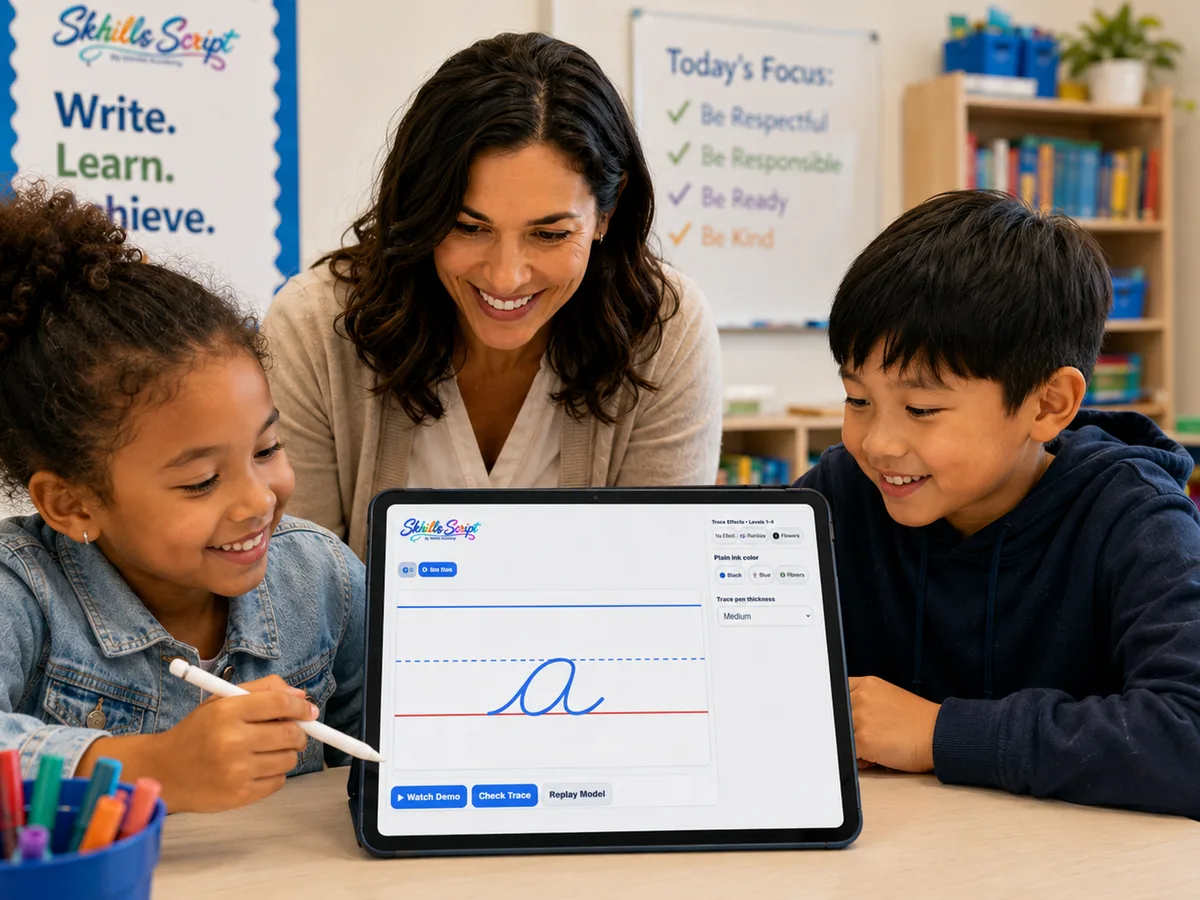
correctly form all 26 lowercase letters. Guided demonstrations, tracing
practice, independent writing and immediate feedback reinforce proper
formation, direction and placement.
The letters are grouped into 5 lessons by the hand movement
they share, so each lesson practices one motion until it starts to feel
automatic.
Taught in 5 lessons, grouped by shared movement
The swing upUndercurve: start on the line, swing up to the middle.
ituwThe bridge overOvercurve: arch up and over, then down to the line.
nmvxyzThe round onesDowncurve: over the top, round to the left, close the oval.
acdgoqThe tall loopsLoop up: climb tall, loop back down through your own line.
elhkbfThe tricky fourThe shapes that follow no rule. Slow and steady.
jprs
Once lowercase formation is established, learners move on to uppercase
cursive. Each capital is introduced with the same structured practice,
helping learners understand size, placement, stroke order, and how
uppercase letters work within cursive writing.
Grouped into 7 lessons by shared movement, in the same way
as the lowercase letters.
Taught in 7 lessons, grouped by shared movement
Capital curvesDowncurve capitals: begin below the top line and sweep left.
ACEOCapital archesCurve forward: up, over, and straight back down.
NMHKCapital tailsCurve forward, finishing with a tail out to the right.
UVWXYZThe double curveDoublecurve: a small wave across the top before the stem.
TFCapital bridgesOvercurve capitals: arch over the top, then down.
IJQThe cane stemCane stem: a tall loop down, then the shape beside it.
BPRDLThe last twoBig looping capitals. The hardest, saved for when you are ready.
GS
Write Your Name
Make cursive personal.
Learners type their own name into Skhillz Script™, and the system renders
it in cursive using the same letterforms they have been learning.
Then they move through Watch, Trace and Write: first they watch their name
being written, then they trace it, and finally they write it
independently.
Because one of the first things children want to write beautifully is
their own name.
Learners begin combining letters into complete words while practicing
consistent spacing, connections, size and flow.
The level includes 100 carefully selected words, among them all seven days
of the week and all twelve months of the year.
By the end of Level 4, learners are no longer simply forming letters. They
are beginning to write connected cursive naturally.
Learners progress from individual words to complete sentences across 75
structured sentence-writing exercises.
As their skills improve the handwriting guides gradually become less
prominent, helping learners move from highly supported practice towards
more natural writing.
The goal is not simply to copy a sentence. It is to develop the rhythm,
spacing, consistency and confidence that everyday cursive writing needs.
Learners put everything they have practiced into longer writing, across 30
five-sentence paragraphs.
At this stage the focus shifts towards sustained handwriting: consistency
across multiple lines, spacing, organization, and keeping cursive readable
over a longer piece of writing.
This is where cursive becomes a practical writing skill rather than an
isolated handwriting exercise.
Learning does not end when the lessons do. In Open Practice, learners can
type any word, sentence, paragraph, assignment or quote they want to
practice. Skhillz Script™ renders it in cursive and gives them the space
to keep developing their handwriting.
A spelling list. A favorite quote. Homework. Vocabulary. Something
completely their own.
The practice can continue as long as the learner wants it to.